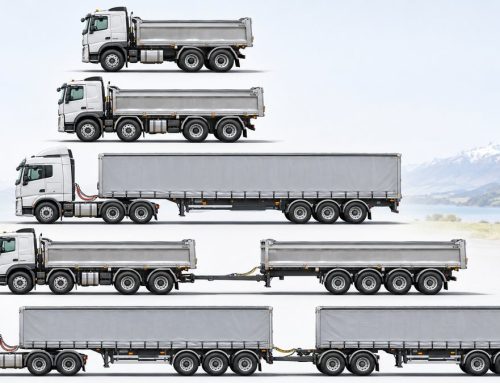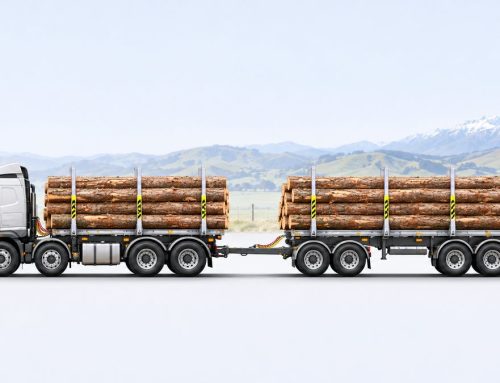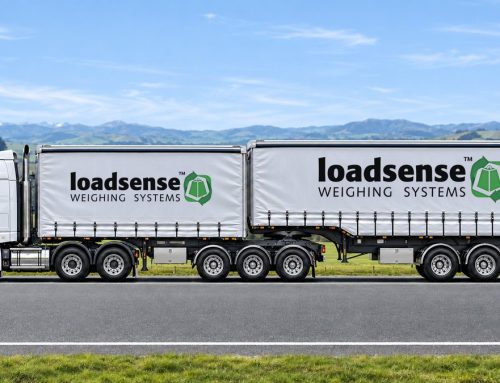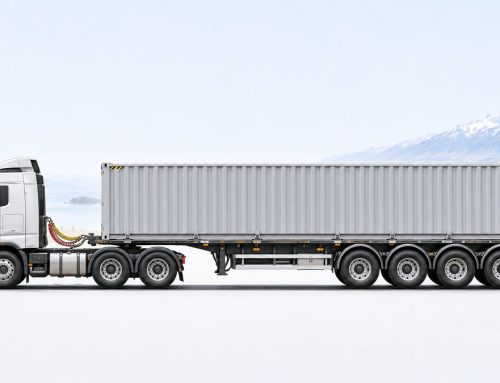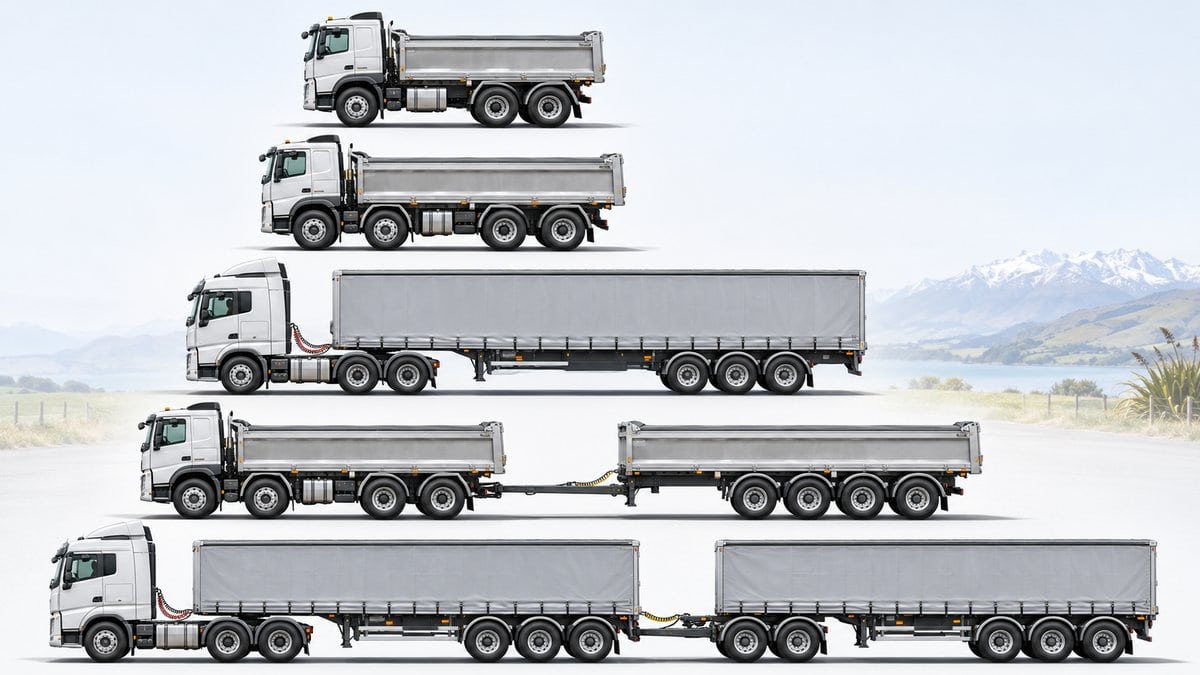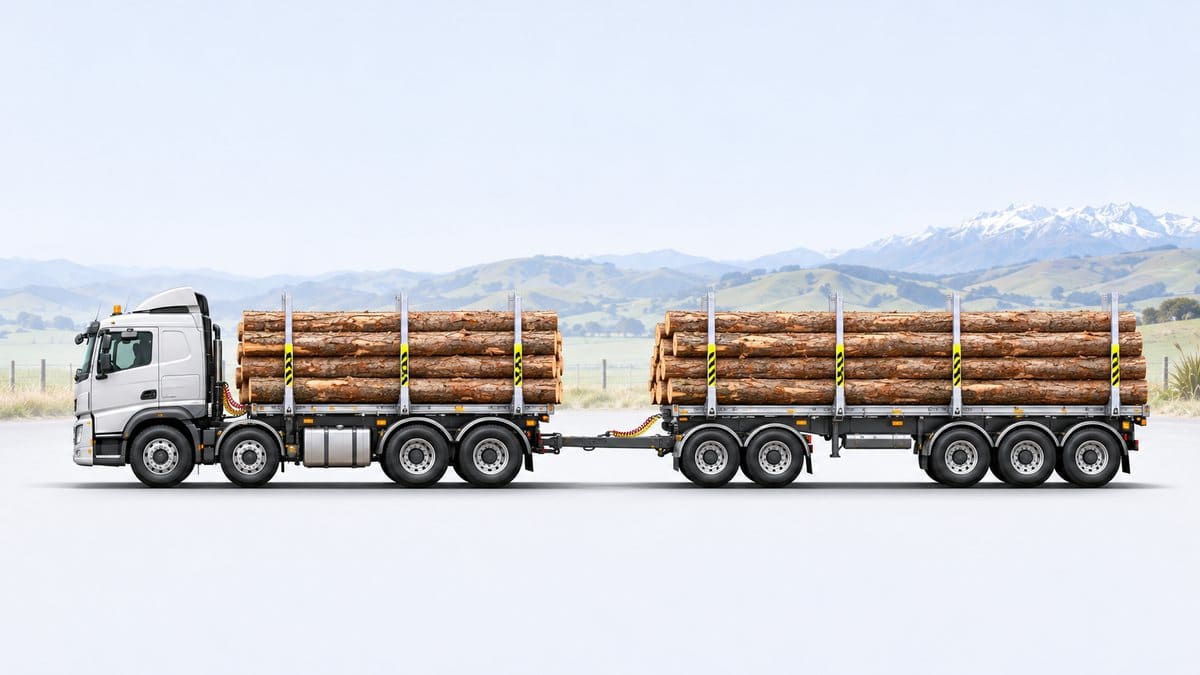
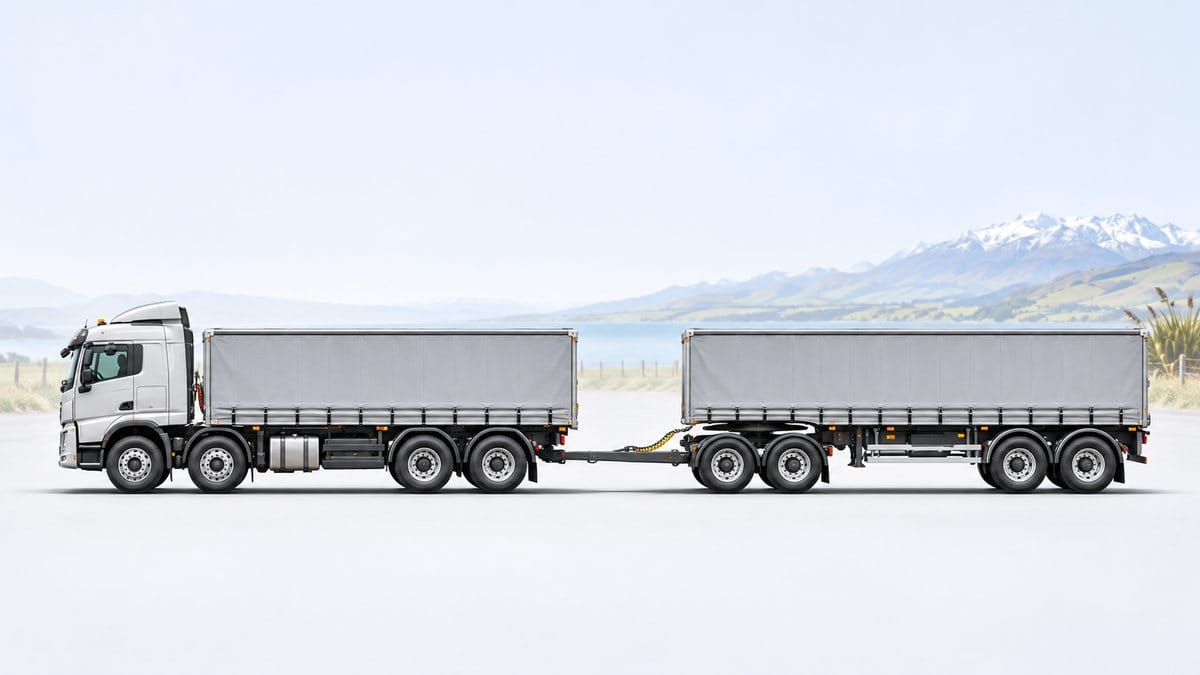
The truck and trailer is the combination most people picture when they think of New Zealand trucking: a rigid truck carrying its own load, towing a full trailer behind on a drawbar. It moves logs, livestock, bulk product, fertiliser and general freight the length of the country.
How a truck and trailer is laid out
The truck is usually an 8×4, sometimes a 6×4. The trailer is a full trailer, which means it carries all of its own weight on its own axles. Its front axles sit on a turntable dolly that steers with the drawbar, and its rear axles are fixed.
| Combination | Truck | Trailer | Total axles |
|---|---|---|---|
| Seven-axle | 6×4 (3 axles) | 4-axle: tandem front, tandem rear | 7 |
| Eight-axle | 8×4 (4 axles) | 4-axle: tandem front, tandem rear | 8 |
| Nine-axle | 8×4 (4 axles) | 5-axle: tandem front, tri-axle rear | 9 |
The four axle groups
An eight-axle truck and trailer has four axle groups, and each has its own limit under general access:
- Twin-steer set: 11,000 kg
- Drive tandem: typically 15,000 kg
- Trailer front tandem: typically 15,000 kg
- Trailer rear tandem: typically 15,000 kg
Add those up and you get 56,000 kg, which is far more than the 44,000 kg general access maximum. That gap is the important point: on a truck and trailer the gross limit is reached long before all four groups are full, so the skill is in spreading 44 tonnes across the groups without putting any one of them over.
Eight axles or nine?
Adding a fifth axle to the trailer creates a nine-axle combination. With the right dimensions and a permit, a nine-axle truck and trailer can run as a 50MAX vehicle at up to 50 tonnes, because the extra axle spreads the load so that road wear per tonne of freight does not increase.
Where truck and trailer loads go wrong
- Uneven split between truck and trailer. A full truck and a light trailer can overload the drive tandem at a legal gross weight.
- Logs. Log length, diameter and moisture vary from load to load, so the same stack height can give very different weights on each bolster.
- Livestock. Animals move, and deck-by-deck loading changes the balance between the trailer’s front and rear groups.
- Bulk product. A bin filled further forward than usual shifts weight onto the twin-steer set.
Weighing a truck and trailer onboard
Each of the four groups gets its own reading. On air suspension, an air pressure sensor is fitted per levelling valve. On mechanical suspension, including most twin-steer front ends, a height sensor measures spring deflection. The trailer’s sensors report wirelessly, so there is nothing extra to plug in when the trailer is coupled, and the truck can pull different trailers.
The driver sees twin-steer, drive, trailer front, trailer rear and gross weights together on the phone. At a skid site or a silo with no weighbridge nearby, that is the difference between loading to 44 tonnes with confidence and leaving two tonnes of paying freight behind to be safe.
Truck and trailer or B-train?
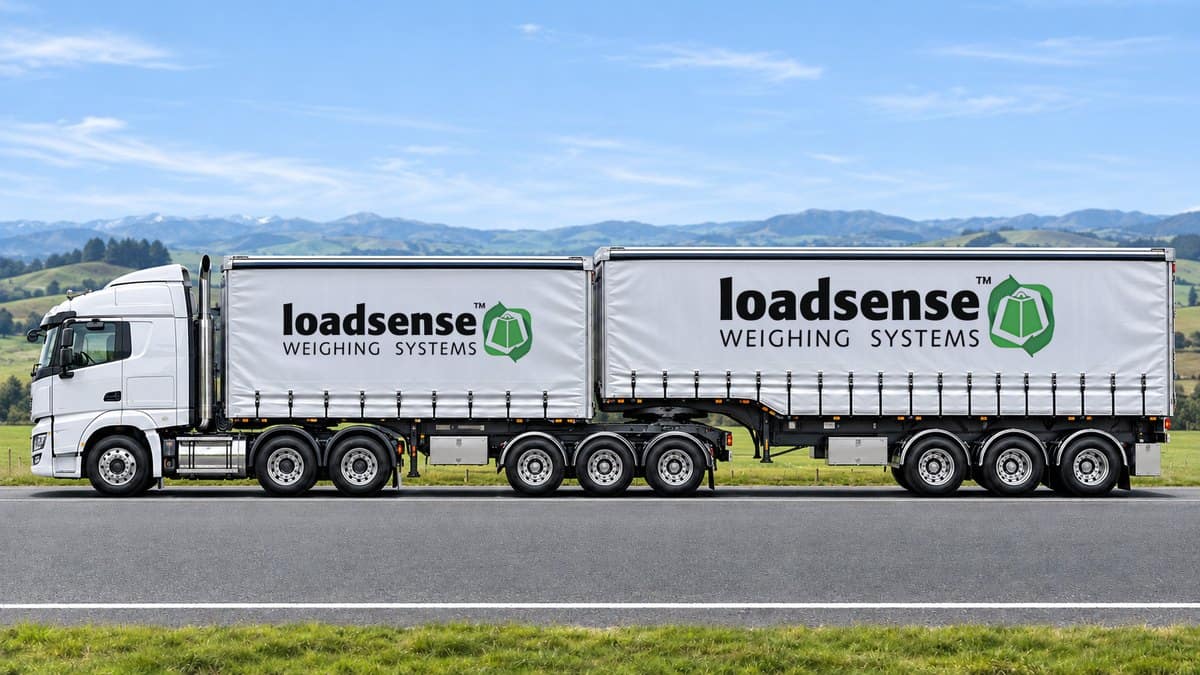
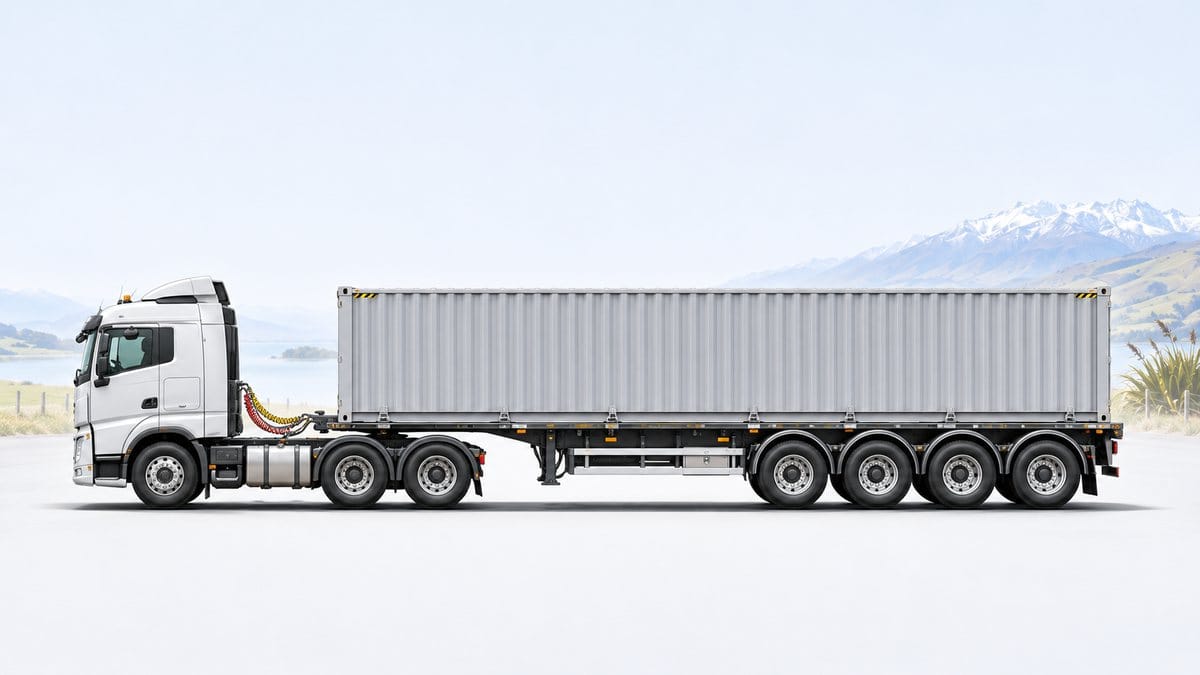
A truck and trailer copes better with tight, rough access and can drop the trailer to work as a rigid. A B-train suits dock-to-dock freight and containers. Both have four axle groups to manage, and both are eligible for 50MAX as nine-axle combinations.
More in this series
- NZ truck and trailer configurations: the complete guide
- 4×2 and 6×2 trucks
- 6×4 trucks
- 8×4 trucks
- B-trains
- Semi-trailers
- 50MAX and HPMV
Know every axle group weight before you leave the yard
The Loadsense Titan Pro onboard truck and trailer scale reads each axle group separately and shows the weights on your phone, so you can load to the limit of your configuration with confidence. Try the free axle weight calculator, or contact the Loadsense team on +64 21 447 151 to talk through your truck and trailer setup.
Weights and limits in this article are a general guide, correct to the best of our knowledge in November 2026. Limits depend on tyre type, axle spacing, vehicle ratings and permit conditions, so always confirm against the current Vehicle Dimensions and Mass Rule, NZTA guidance and your own permit. An onboard scale is a loading aid and does not replace a certified weighbridge.