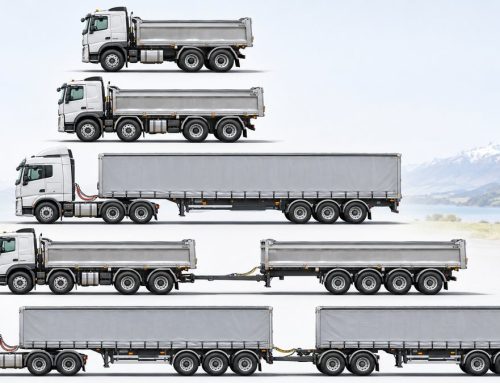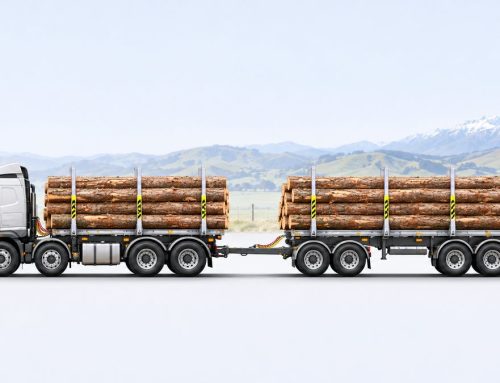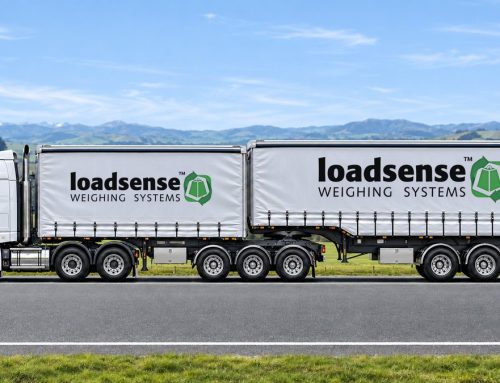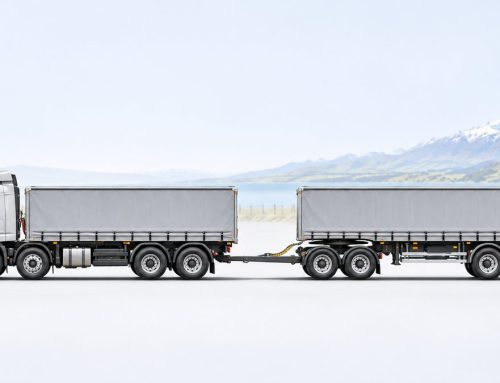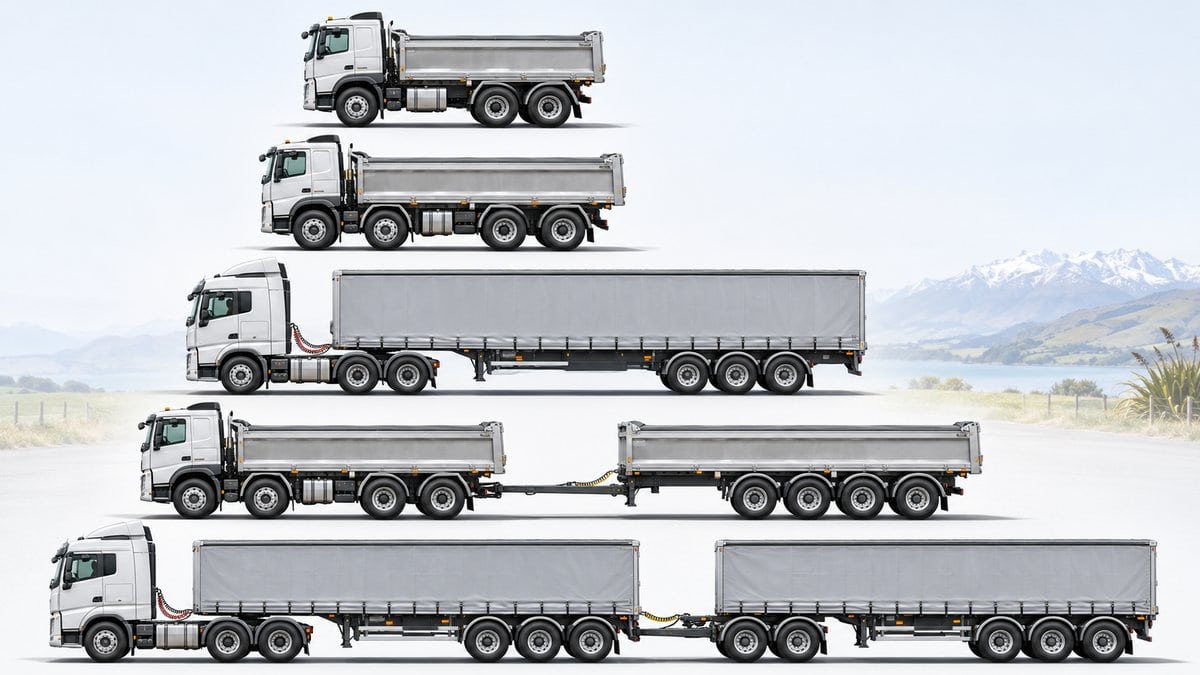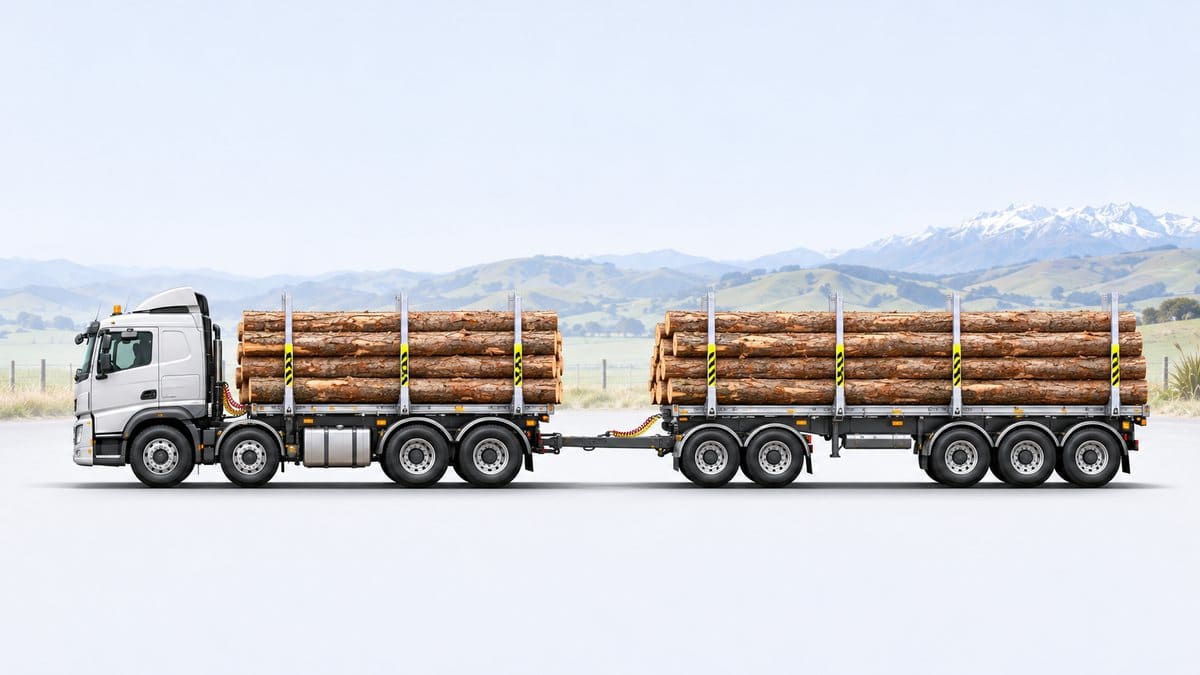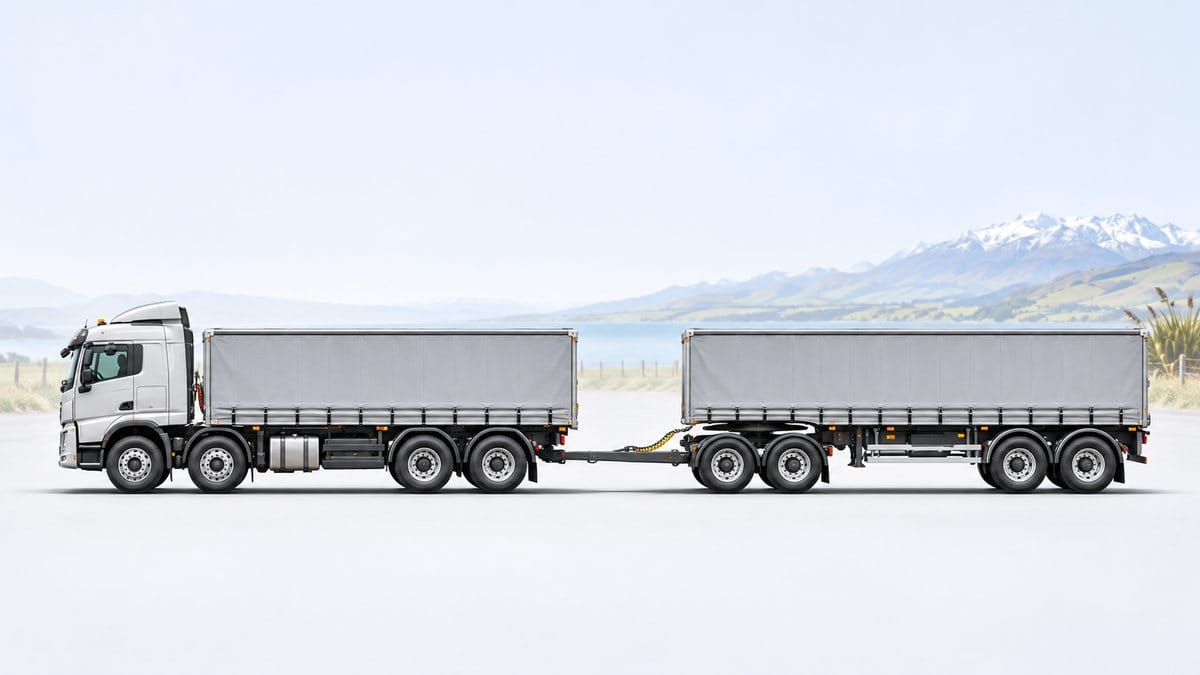
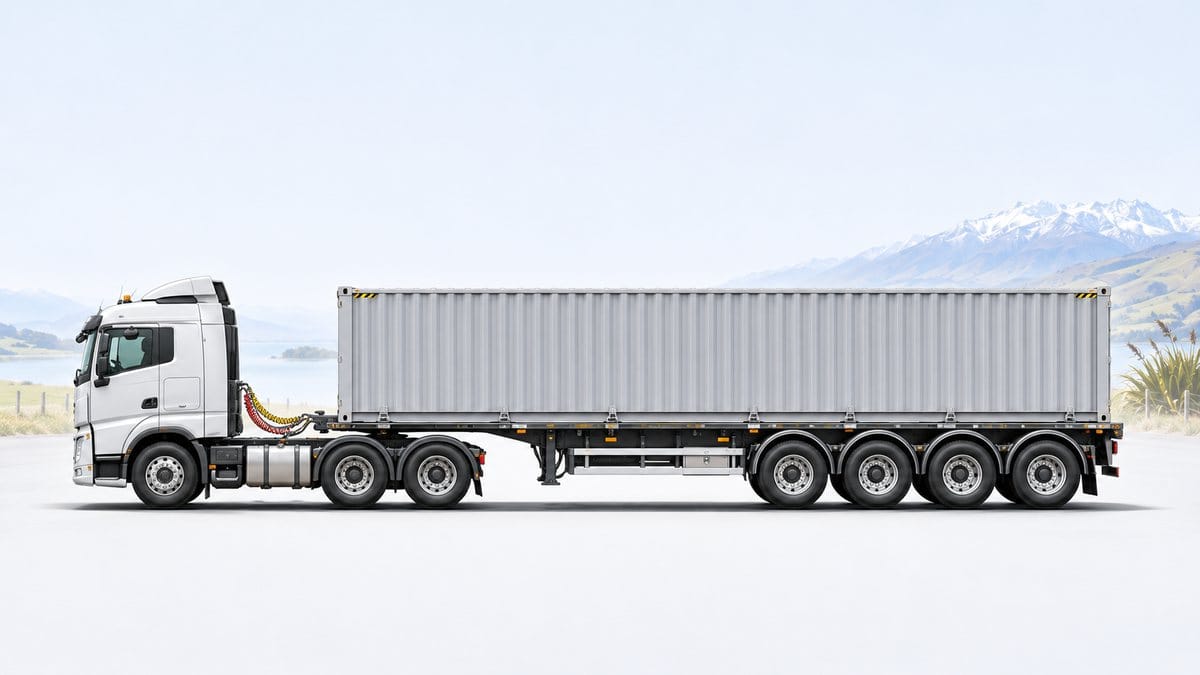
The tractor and semi-trailer is the simplest articulated combination: one tractor unit, one trailer, one fifth wheel. In New Zealand it does much of the container, refrigerated, tanker and machinery transport work, especially where a single long deck or easier site access matters more than maximum payload.
How a semi-trailer carries its load
A semi-trailer has axles only at the rear. The front of the trailer rests on the tractor’s fifth wheel through the kingpin, so part of every load is carried by the tractor’s drive axles. That is the difference from a full trailer, which stands on its own axles at both ends.
Common layouts
| Combination | Tractor | Trailer | Total axles |
|---|---|---|---|
| Six-axle | 6×4 | Tri-axle semi | 6 |
| Seven-axle | 6×4 | Quad-axle semi | 7 |
| Five-axle | 4×2 | Tri-axle semi | 5 |
Quad-axle semis are common in New Zealand because the fourth axle allows more weight on the trailer group. They are often fitted with a steering rear axle to reduce tyre scrub in tight turns. Low loaders, swinglifts and skeletal container trailers are all variations on the same idea.
Three axle groups
- Steer axle: 6,000 kg on standard single tyres
- Drive tandem: typically 15,000 kg
- Trailer group: up to 18,000 kg for a twin-tyred tri-axle set at the widest spacing, and more for a quad-axle set
The combination’s gross weight is also limited by its axle count and by the distance from the first axle to the last, and for most semis that keeps the legal gross below the 44,000 kg general access maximum. Check the figures for your own combination.
The balancing act
With only three groups, where the load sits along the deck decides everything. Slide a load forward and weight moves from the trailer axles to the drive tandem. Slide it back and the trailer group goes up. A dense load, such as a 20-foot container or a single machine, can overload one end of the combination while the gross weight is nowhere near the limit.
Container work is the classic example. A heavy 20-foot box placed at the front of a skeletal trailer loads the drive axles; at the rear it loads the trailer group. A 40-foot box packed heavy at one end does the same thing in a way the driver cannot see.
Weighing a semi-trailer onboard
A semi weighs as three groups. On air suspension, one air pressure sensor per levelling valve reads the drive tandem, and another reads the trailer’s tri-axle or quad-axle group. On mechanical suspension, height sensors measure spring deflection. The steer axle is measured with a height sensor or air sensor depending on the front suspension.
Because the trailer sensor reports wirelessly to the driver’s phone, a tractor can swap between trailers and still show the correct weights, as long as each trailer has been calibrated.
For swinglift operators the benefit is immediate: lift the container on, read the drive and trailer group weights, and reposition the box before leaving if either group is over.
When to choose a semi over other combinations
A semi suits long or indivisible loads, sites with limited turning room, and work where trailers are dropped and swapped. When maximum payload on divisible freight is the goal, a B-train or truck and trailer carries more.
More in this series
- NZ truck and trailer configurations: the complete guide
- 4×2 and 6×2 trucks
- 6×4 trucks
- 8×4 trucks
- Truck and trailer combinations
- B-trains
- 50MAX and HPMV
Know every axle group weight before you leave the yard
The Loadsense Titan Pro onboard truck and trailer scale reads each axle group separately and shows the weights on your phone, so you can load to the limit of your configuration with confidence. Try the free axle weight calculator, or contact the Loadsense team on +64 21 447 151 to talk through your truck and trailer setup.
Weights and limits in this article are a general guide, correct to the best of our knowledge in November 2026. Limits depend on tyre type, axle spacing, vehicle ratings and permit conditions, so always confirm against the current Vehicle Dimensions and Mass Rule, NZTA guidance and your own permit. An onboard scale is a loading aid and does not replace a certified weighbridge.